
Newsletter August 2026
Out of Sports: Getting all girls and women off the playing field
By now, if you are in the U.S., you no doubt have heard the relentless Republican rallying calls to “get men out of girls’ sports.” It’s the argument used to demonize trans girls and women who play on girls’ or women’s teams and drive them out of school/college sports altogether.
Needless to say, this is an entirely made-up issue used by far-rights actors to generate anxiety and anger about alleged unfairness and potential exposure to male genitals in locker rooms, and to justify a much broader range of attacks on trans persons in general.
Bad as that is—and it’s really bad!—we have to understand that it won’t stop there. Attacks on trans girls and women will end up harm all girls and women seeking to participate in sports and drive them off the field. In fact, that is one of the explicit goals of this witch hunt, as recent events make clear.
A devastating blow to trans girls and women in sports
On June 30, 2026, the Supreme Court of the United States, in West Virginia v. B.J.P. and Little v. Hecox, ruled by a 6-3 majority that states can ban trans girls and trans women from girls’ and women’s sports teams just by virtue of who they are. In March 2020, Idaho had been the first state to pass a law to ban trans girls from girls’ sports teams, from elementary school through university. After that, 26 other states (all with Republican-controlled legislatures) enacted similar bans in rapid succession.
The right-wing majority of the Supreme Court dismissed the idea that banning trans girls violated Title IX, the landmark 1972 federal civil rights law that forbids sex discrimination in education. Title IX is not a sports law: it applies to all education programs and schools that receive federal funding. But the application of Title IX to school sports has led to a great upsurge in girls’ and women’s participation in sports in the U.S.
The Supreme Court based its decision on a definition of sex as “biological sex,” rather than an approach that also encompasses gender identity and sexual orientation. The Biden Administration had adopted that broader understanding of sex and issued an Executive Order to that effect in March 2021, contradicting guidance issued by the first Trump Administration. In January 2025, the Biden Executive Order was repealed when Donald Trump issued Executive Order No. 14168 entitled "Defending Women from Gender Ideology Extremism and Restoring Biological Truth to the Federal Government.”

This means denying trans girls in those states a chance to participate in any team sports at school. We’re not even talking about competitions or tournaments. Notice also how trans boys and men (who were assigned the female sex at birth) are not being policed under these laws, since the assumption is that they will be worse competitors than cis men and boys; no one seems to care about those actual “biological females at birth” sharing locker rooms with cis men and boys.
Notice also how none of this is about protecting female athletes from the actual sexual abuse, rape and psychological violence so many have experienced while engaged in school, collegiate and Olympic sports. “U.S. Gymnastics Sex Abuse Scandal” has its own Wikipedia page that documents the sexual abuse of over 500 gymnasts (mostly minor girls) by coaches, gym owners, team doctors and others over two decades. No, the far-right says, the only protection we owe children is to protect cis girls from trans girls. Underlying all of this is the notion that any male is inherently a superior athlete to any female, at any age and no matter the sport−something that’s far from clear.
Notice also that the Supreme Court decision on trans girls in sports came just over a year after the same court, in U.S. v Skrmetti, also by a vote of 6-3, upheld a Tennessee law banning the use of puberty blockers and hormone therapy by transgender teenagers. This becomes a Catch-22, where just existing as a trans child becomes untenable in certain U.S. states.
How did this wave of legislation come about? You’d think hordes of trans girls have tried to join school sports teams, causing havoc and winning all the medals. For starters, there are very few trans kids or young adults overall. Trans people make up about 1% of the U.S. population, and 3.3% of youth aged 13-17. Of these approximately 725,000 youth, a third identify as trans girls, a third as trans boys, and a third consider themselves non-binary. In 2024, the president of the National Collegiate Athletic Association (NCAA), former Republican governor of Massachusetts Charlie Baker, said in testimony before Congress that fewer 10 out of 510,000 college athletes were transgender at the time.
Neither is it because the very few trans girls participating in school sports have caused problems. When interviewed by Associated Press journalists in 2021, sponsors of these laws were not able to point to any issues caused by the participation of trans girls on school teams:
“In South Carolina, for example, Rep. Ashley Trantham said she knew of no transgender athletes competing in the state and was proposing a ban to prevent possible problems in the future. Otherwise, she said during a recent hearing, ‘the next generation of female athletes in South Carolina may not have a chance to excel.’
In Tennessee, House Speaker Cameron Sexton conceded there may not actually be transgender students now participating in middle and high school sports; he said a bill was necessary so the state could be ‘proactive.’”
What is going on is an anti-trans campaign by the Alliance Defending Freedom (ADF), the same well-funded Christian far-right group that’s also behind Supreme Court cases against abortion and LGBTQ persons. ADF provided the model anti-trans laws adopted by US states and has represented plaintiffs in several cases against trans participation in sports. By the way, ADF now has an established presence in Europe so it can attack gender equality and sexual and reproductive rights there.
The U.S. trans athletes whose cases keep being whipped up in the media by ADF and other far-right actors are so few, I can list them here. Between 2017 and 2019, trans girls and high school sprinters Terry Miller and Andraya Yearwood of Connecticut combined to win 15 school championship races, prompting a lawsuit. One of the plaintiffs, a cis girl named Chelsea Mitchell, defeated Terry Miller — the faster of the two trans sprinters — in their final two races in February 2020.
In 2017 and 2018, trans boy Mack Beggs won two Texas high school titles in girls’ wrestling competitions, after he was told Texas athletic policy required he compete on teams corresponding to the sex on his birth certificate (the problem here arising from the policy, not his trans status). Beggs wasn’t some huge man wrestling tiny girls: he competed in the 110 lbs (50kg) division.

At the 2022 NCAA Division I Women’s Swimming and Diving Championships, Penn University swimmer Lia Thomas, who is trans, tied for fifth in the 200-yard freestyle with Riley Gaines, a cis woman. Gaines launched a class action lawsuit (Gaines v NCAA) against the NCAA for violations of Title IX. Gaines didn’t argue she’d been denied a medal by Thomas—when she tied with Thomas for fifth, four cis girls were ahead of them—but that merely having Thomas in the competition deprived cis girls of unspecified opportunities, causing discrimination.
Lindsay Hecox, the plaintiff in one of the Supreme Court cases, tried for track and field at Boise State University but didn’t make the cut. Becky Pepper-Jackson, the B.J.P. in the other Supreme Court case and the only high school trans athlete in West Virginia, had transitioned before hitting puberty and her hormonal makeup was similar to those of cis girls her age. She was not allowed to join her high school’s track team.
That’s it. Those are the cases. If trans women and girls were really dominating sports, we’d know about them. Instead, the people who demonize them, like Riley Gaines and Women’s National Basketball Association (WBNA) player Sophie Cunningham, are the ones who’ve become famous.
It’s tempting to retort that, since there are so few trans persons or trans athletes, it's a marginal issue in women’s sports that we shouldn’t spend energy on. I argue the opposite: trans persons are human beings whose dignity and human rights must be respected, protected and fulfilled, period. And it’s politically important to understand that the far-right is demonizing this small group of marginalized people specifically because they think they can get away with it and use it to stoke culture wars. Their cynical calculation appears to have paid off.
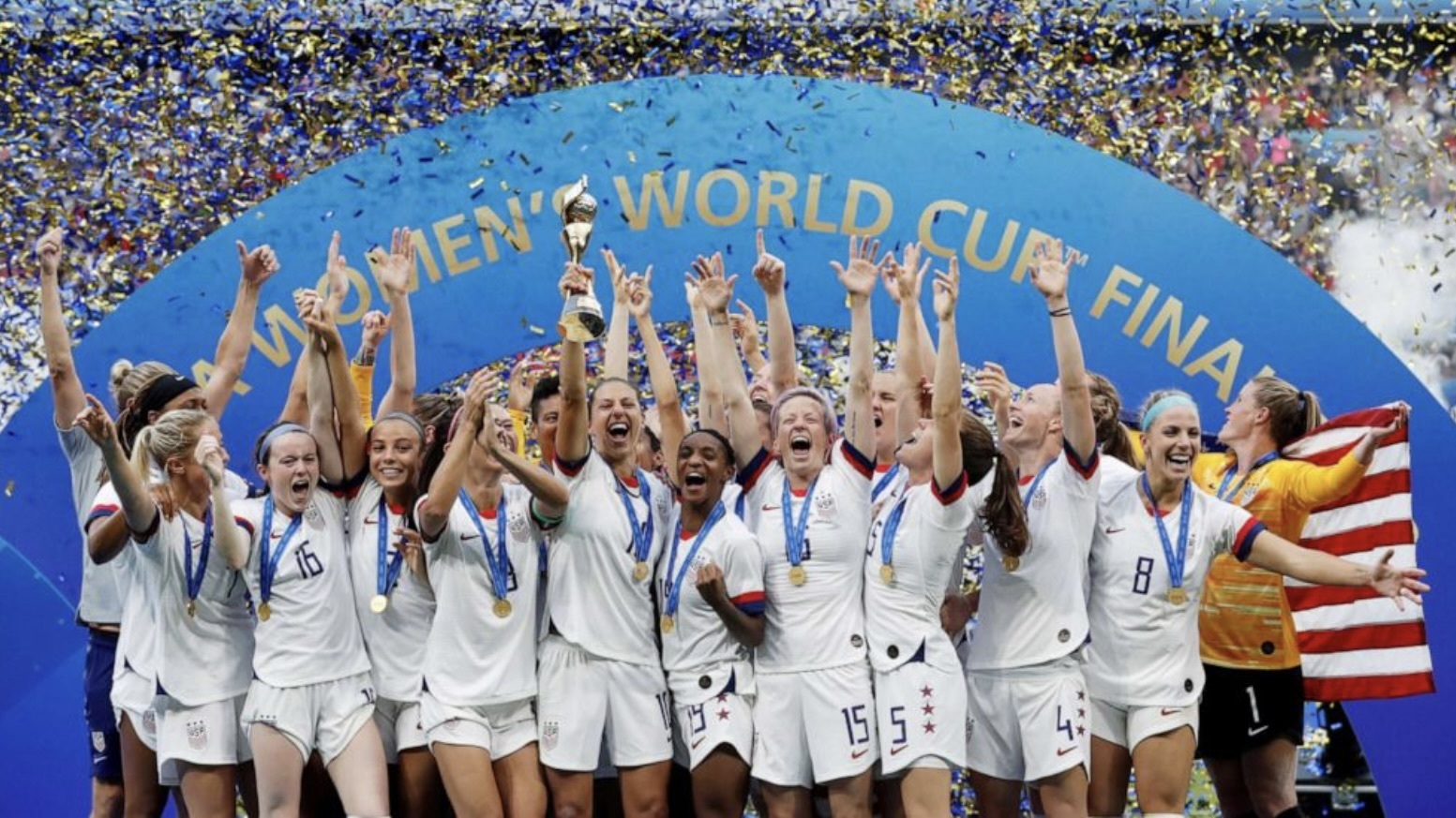
I think a distinction can arguably be made between school athletes and elite athletes, and that different requirements can be set for those who compete at collegiate, Olympic and world level. Megan Rapinoe, the out lesbian Olympic soccer gold medalist and two-time World Cup champion who is a staunch trans ally, makes that point in a recent interview. For example, before 2022, the NCAA had a policy governing sports eligibility that required a year of testosterone lowering medication (as prescribed by their doctor) for trans girls and women to compete. The World Professional Association for Transgender Health (WPATH) maintains standards of care for the health of trans people, which include detailed guidance on gender-affirming hormonal treatment. And remember that most trans kids and young adults do request gender-affirming care. It’s not an unworkable or insurmountable question if addressed in good faith, based on science and in consultation with trans athletes themselves. But that's not what’s going on right now.

Moreover, available evidence on trans girls or women athletes on gender-affirming hormonal therapy (testosterone suppression and estrogen supplementation) shows they have no physical advantage over cis competitors. A meta-analysis of all existing studies just published in the British Journal of Sports Medicine concluded that “the current data do not justify blanket bans [on trans athletes].” While “trans women had higher absolute lean body mass than cis women,” the authors found there were “no significant differences in physical fitness metrics, such as upper-body strength, lower-body strength, and maximum oxygen consumption after the trans women underwent one to three years of gender-affirming hormone therapy. In fact, the absence of strength disparities between transgender women and cisgender women found in the current review was consistent, and contradicts narratives framing male puberty as conferring irreversible athletic advantages despite [gender-affirming hormone therapy],” the authors remarked.
In fact, a 2024 study carried out in the UK at the IOC’s own request showed that trans athletes were at a disadvantage in some areas as compared to cis athletes; trans women athletes, for example, had a higher level of body fat, possibly tied to hormonal therapy. The authors concluded the results should “caution against precautionary bans and sport eligibility exclusions.”
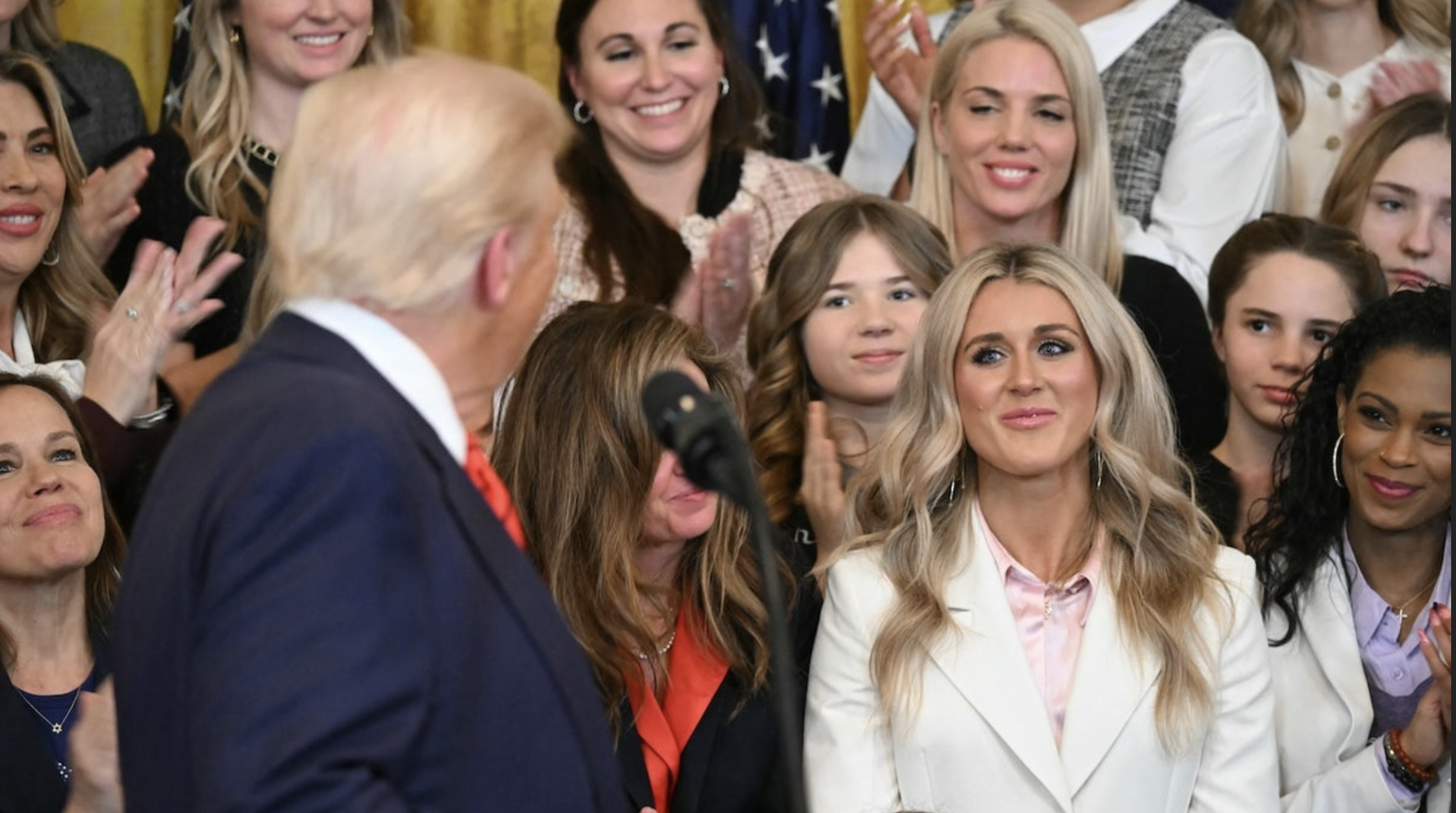
But this evidence was rejected by Gaines and other plaintiffs in their lawsuit, because inclusion or participation wasn’t their goal. They wanted the NCAA to completely ban trans women and girls from ever competing on women’s and girls’ teams. When Donald Trump signed his executive order on biological sex in January 2025, Riley Gaines was proudly standing behind him. The next month, the NCAA caved, and issued a new policy banning any athlete who was assigned male at birth from competing on girls’ and women's teams. The far-right got what they wanted.
This has been devastating to the small number of trans girls and women who participate in school and college team sports. And this ruling will have wider ramifications. For example, Washington State ballot measure IL26-638, up for a vote this November, would require all girls—but not boys—to be medically sex certified before they can play sports, most likely via genital exams. “In a country rife with sexual assault, young girls would have to undergo invasive inspections of their genitals, or pay for a DNA or hormone test, as part of their school sports physicals,” noted Rapinoe in a recent op-ed in Marie-Claire. This will discourage many young girls from playing sports.
This witch hunt harms Olympians too. At the 2024 Paris Olympics, a huge hullabaloo was generated by right-wing media and amplified by Donald Trump over Algerian boxer Imane Khelif, who was falsely accused of being a man. Khelif was born in Algeria, was assigned the female sex at birth, grew up as a woman and has always competed as a woman. The attack against her began in 2023, when the Russia-led International Boxing Federation (IBA), claiming Khelif had failed unspecified sex tests, disqualified Khelif after she defeated Russian boxer Azalia Amineva at the IBA Women’s Championship. The IBA is so very corrupt that the International Olympic Committee (IOC) suspended the IBA in 2019 as the governing body for Olympic boxing.
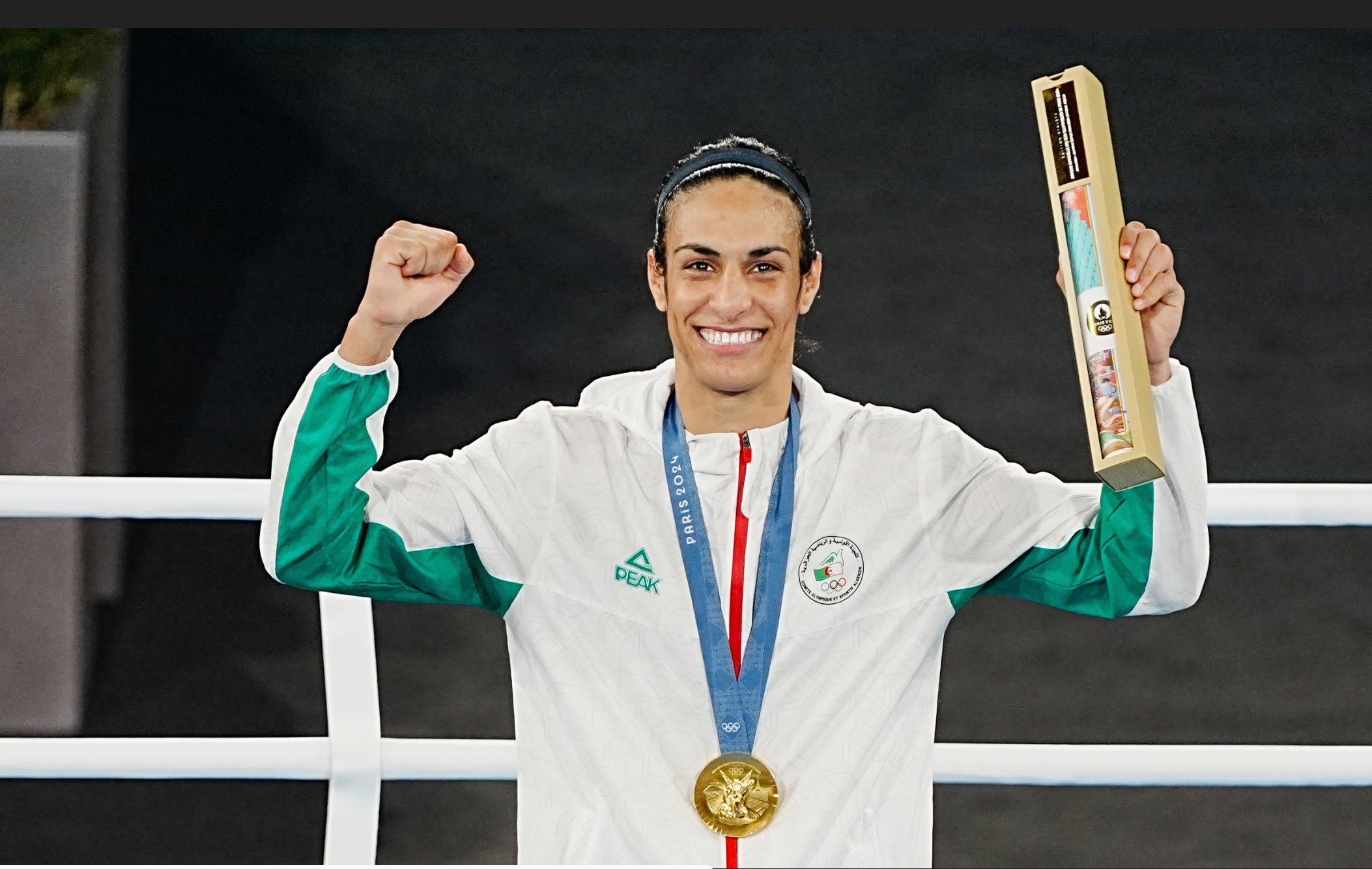
Yet media jumped on the bandwagon to speculate about Khelif’s sex and body, and even progressive media seemed unable to sort out the facts and the science. Fortunately, the IOC stood their ground at that time, declaring that Khelif has met all the conditions required of any female competitor and there was no reason to single her out. Khelif went on to win the Olympic gold medal in her category. And yet, the insinuations and attacks against Khelif continued regarding her genetic makeup, testosterone levels and more, as recent interviews and articles by CNN, The Guardian, French sports newspaper L’Équipe, and others, attest. It’s truly disgusting. What Olympic athlete doesn’t have a physical makeup that is, in some respects, exceptional? It’s not unfair: it’s a natural advantage, like height, flexibility, strength, large lungs or swimmer Michael Phelps’ exceptionally long hands and feet.
Caving to U.S. political pressure, the IOC announced in March 2026 a new Policy on the Protection of the Female (Women’s) Category in Olympic Sport and Guiding Considerations for International Federations and Sports Governing Bodies. Going forward, only those women who pass a one-time gene test showing absence of the SRY gene (one of the many genes tied to male sexual development in utero) will be allowed to compete in women’s competitions.
Andrew Sinclair, the Australian geneticist who discovered the SRY gene, vehemently disagrees with using it to determine sex: “It is simplistic to take the SRY gene and declare it the ultimate decider of maleness. Male sex is much more complex, involving multiple genes other than SRY in developmental pathways as well as hormones. The presence or absence of the SRY gene does not determine the range of human sex characteristics. Individuals with differences of sex development may carry the SRY gene but develop either complete or partial female bodies, while others develop male bodies but lack SRY. All the SRY test tells you is whether or not the gene is present. It does not tell you how SRY is functioning, whether a testis has formed, whether testosterone is produced and, if so, whether it can be used by the body."
This new policy is almost identical to a policy the IOC discontinued in 1999 over concerns about numerous inaccuracies, the high costs of testing and the psychological trauma it caused unsuspecting athletes. Except this time, it’s going to be worse, because neither the IOC itself nor the host committee will be administering the SRY test as they did pre-1999. They will leave it to individual sport federations and governing bodies, not all of which have the capacity to run genetic testing. Hello confusion and corruption!
A complete mess. By the way, between 1999 and 2024, when the IOC let individual sports federations (except the corrupt IBA) set the requirements for trans athletes to compete in their sport, only one trans woman competed in the Olympics: New Zealand weightlifter Laurel Hubbard, in Tokyo in 2021. Hubbard finished last in her group.
Yannis Pitsiladis, the lead researcher on the 2024 IOC-commissioned study mentioned above, had this to say about the IOC and other federations’ recent willingness to disregard evidence: “their wish is mainly to appease their membership and the decisions being taken are mainly justified by politics and dictates, rather than science.”
That’s right. So, we shouldn’t be surprised when this ongoing attack on trans women sweeps up any woman who doesn’t look “feminine enough” and when it drives talented athletes off the playing field. And we shouldn’t be shocked that BIPOC women like Khelif—or South African runner and Olympic gold winner Caster Semenya, who was hounded for years for having naturally high testosterone levels—continue to be prime targets for these attacks.
Attacking all women’s and girls’ sports
But that’s not all.
In July 2026, the Heritage Foundation (of Project 2025 fame) published a paper entitled Title IX’s Failed Experiment: Why Accommodating Sex Differences Beats Engineered Parity, by Boise State University (Idaho) political science professor Scott Yenor. Yenor is a noted Christian nationalist and anti-feminist, who describes college campuses as “indoctrination camps” and “citadels of our gynecocracy,” and career women as “medicated, meddlesome and quarrelsome.” Yeah, listening to Yenor does in fact make me much more quarrelsome.

In this Heritage Foundation paper, Yenor argues that Title IX should no longer apply to school and college sports and that competitive women's sports should be replaced with "cheerleading, dance, yoga, hiking clubs, recreational intramurals, and other athletic opportunities more aligned with average female interests and tendencies.”
Yenor is strangely fascinated by French philosopher Simone de Beauvoir, who is referred to 23 times in the 24-page report, although Beauvoir clearly had nothing to do with Title IX. He claims that, in her 1949 essay The Second Sex, Beauvoir called for an “aggressive, dominance-oriented female athlete.” I pulled out my dog-eared copy of Le Deuxième Sexe to see what Beauvoir actually wrote. I only found brief comments about the impact of being deprived of access to sports, including competitive and combat sports. These few sentences, in Beauvoir’s chapter on adolescent girls, are part of her overall analysis of the many very real deprivations experienced by girls and young women at that time, but they are hardly her central point.

The Heritage Foundation needs a bogeywoman, and the socialist, feminist, French, unmarried Beauvoir is convenient. I have to say that, in outlining Beauvoir’s views at length, Yenor does highlight what a groundbreaking thinker she was at that time: it was then absolutely radical to argue that a woman should “define herself though sovereign projects of her own choosing,” rather than submit to a passive destiny defined by her biology. Thank you Scott.
From his fabulation about Beauvoir, Yenor vaults into his critique of Title IX. He is particularly incensed with Title IX’s requirement of proportionality between athletic participation and undergraduate university enrollment by sex. Brown University, the defendant in the landmark Title IX case that established that test, had, as a result, to “invest millions of dollars in upgrading its facilities, hiring coaches, and improving its scheduling to create new prospects for women’s athletics.” That sounds about right, doesn’t it?
Colleges and universities didn’t do this willingly: they had to be repeatedly dragged to court over Title IX implementation. When Brown University tried to count unfilled roster spots on the girls’ volleyball team as part of its total, courts ruled that roster spots had to be filled to count. Dismissing “safety” concerns about contact sports as gender stereotypes, courts also ruled that offering boy-only wrestling, judo and other contact sports was discriminatory. Judges further specified that relegating girls play to weeknights while only the boys got to play on Friday nights undermined community interest and the development of a fan base for girls’ teams.
So the problem with Title IX is…?
Well, you guessed it: Yenor’s claims that Title IX harms boys’ and men’s sports. “Colleges learn that the safest (and often cheapest) path to compliance was cutting men’s non-revenue programs rather than adding women’s teams or controlling costs in [American] football and men’s basketball.” That is a choice: rather than raising more funds to provide opportunities for girls and women, colleges and universities chose to cut men’s tennis, fencing, golf, volleyball and the like, while doubling down on their two money-making men’s sports, American football and basketball.
But there is another, deeper concern: Yenor argues that sports are making girls and women less feminine. Yenor piles on various claims, without presenting evidence, to make his case: “Sports as implemented under Title IX are designed to educate women toward a new character,” “to make the non-competitive, feminine women less thinkable and tenable,” “to manipulate women’s behavior in ways favored by certain women’s groups,” “to impose an androgynous, high-competition model on women’s athletic endeavors,” “favoring a male-normed ‘elite’ and competitive vision of women’s sports at the expense of broader, more feminine-friendly offerings.” I’ll spare you the rest.
Yenor claims throughout that women have naturally less interest in sports, even as he notes the spectacular growth in women’s and girls’ participation that resulted from Title IX. For example, according to the NCAA, the number of women’s college soccer programs grew from 631 in 1995 to 1,035 in 2022, while women’s rowing crews went from fewer that 150 in 2015 to more than 300 in 2022. A 2022 report from the Women’s Sports Foundation notes that, since Title IX was enacted, the number of high school girls playing competitive sports has risen from 300,000 to 3.4 million.
And yet, despite this spectacular progress, women’s athletic participation still lags behind men’s. The Women’s Sport Foundation finds that men still have 60,000 more sports opportunities in college than women, and that BIPOC women are still disadvantaged as compared to white women. So there’s more work to do!
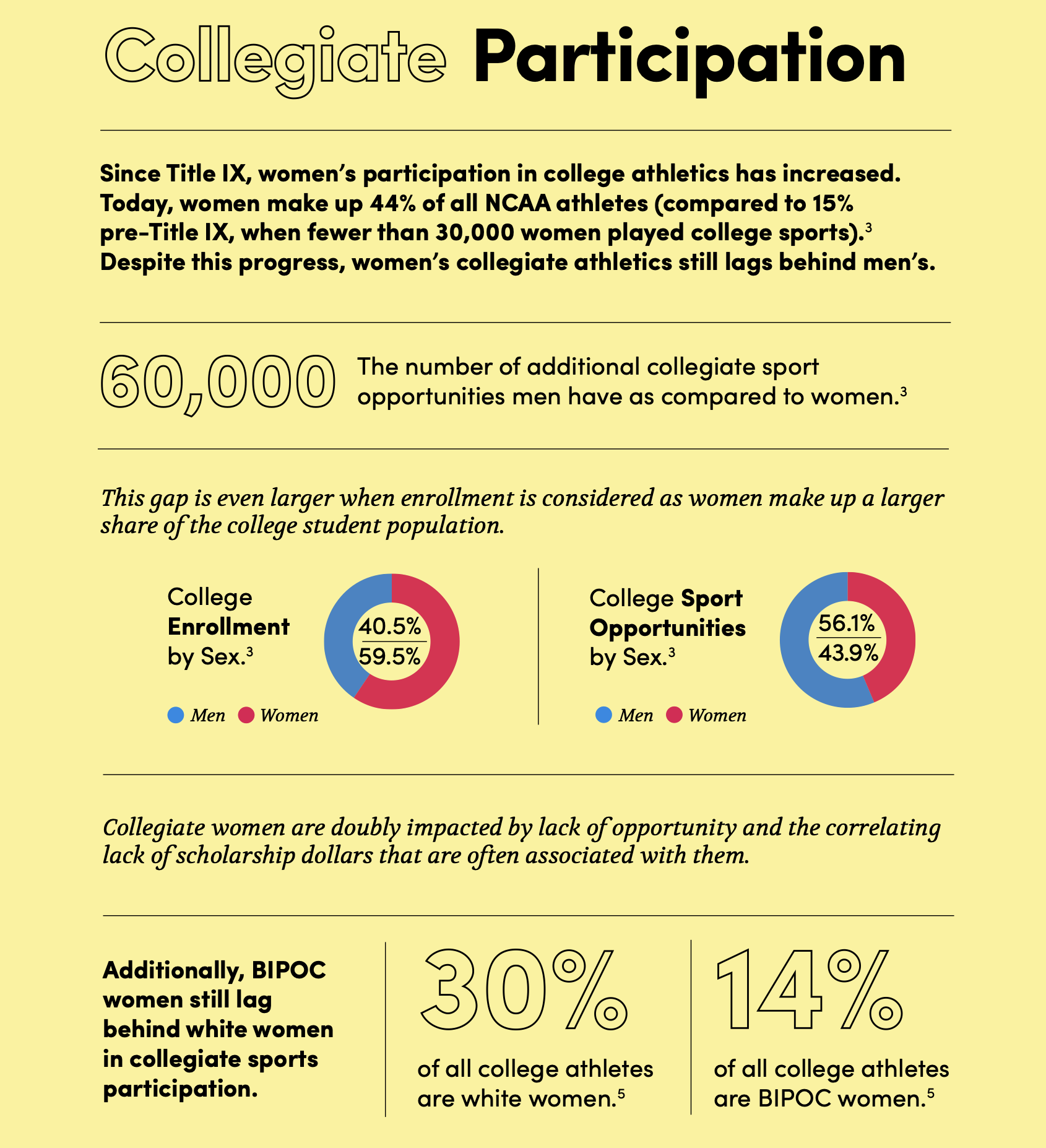
Yenor turns these statistics on their head to argue that this lag is evidence of women’s natural lack of interest in sports, “even after decades of heavy-handed policy.” He then pivots to adult (post-college) male participation in recreational and competitive sports in the U.S. and worldwide−which he finds, oh surprise! to be much greater than women’s−as additional evidence of this alleged lack of interest. For a scholar concerned with feminism, Yenor seems not to have heard of women’s gendered, double burden of paid employment and household and care work. Women everywhere have much less free time than men.
The Heritage Foundation’s goal? To do away with Title IX’s proportionality requirement, and focus on “activities that build health, good habits, vigor, bodily toughness, grace, confidence, social connection of teamwork, and beauty.” (oh please) “And the clincher: “Moderate exercise supports fertility and mental well-being far more reliably than does the high-intensity, elite model of sports.”
So girlfriends, it’s back to dance and cheerleading so we can be graceful and make babies. This will also allow schools and colleges to “protect and perhaps expand male opportunities” by reinvesting in men’s and boys’ sports. After all, “competition is much more central to male identity” and “sports are also central to make friendships,” both of which “have suffered under the weaponized application of Title IX.”
Phew.
These attacks will only be intensifying as we head into the U.S. midterm elections. Gotta get that rage baiting going! Not coincidentally, a few days ago, former NBA basketball players Royce White and Enes Kanter Freedom announced they were declaring for the WNBA draft. These two trolls claim they’ve decided they’re women. Of course, right-wing media is running with this manufactured nonsense to denigrate trans women and attack the WBNA and women’s sports, even as these very same media outlets prop up rapists, sex traffickers and violent abusers for elected office.
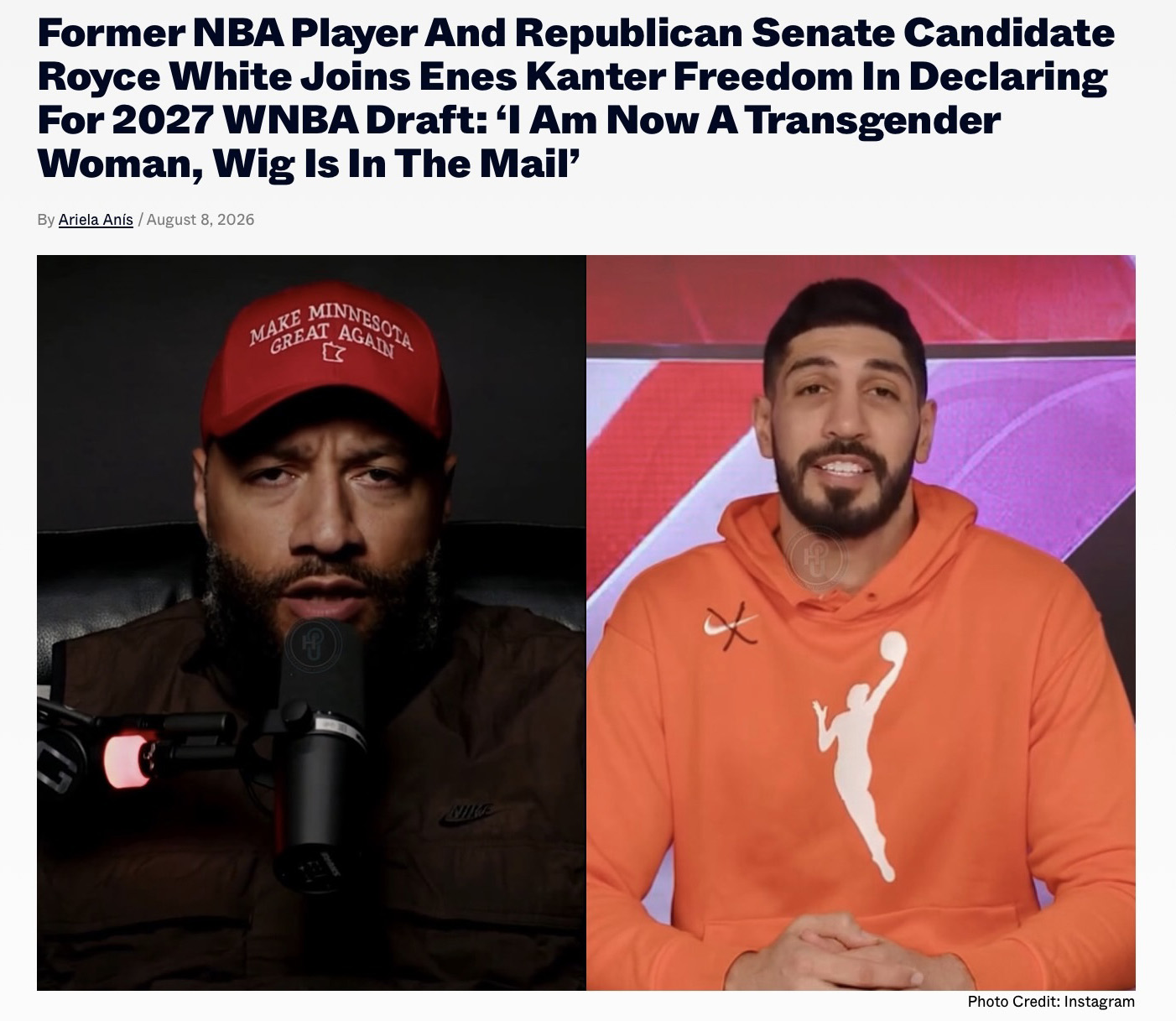
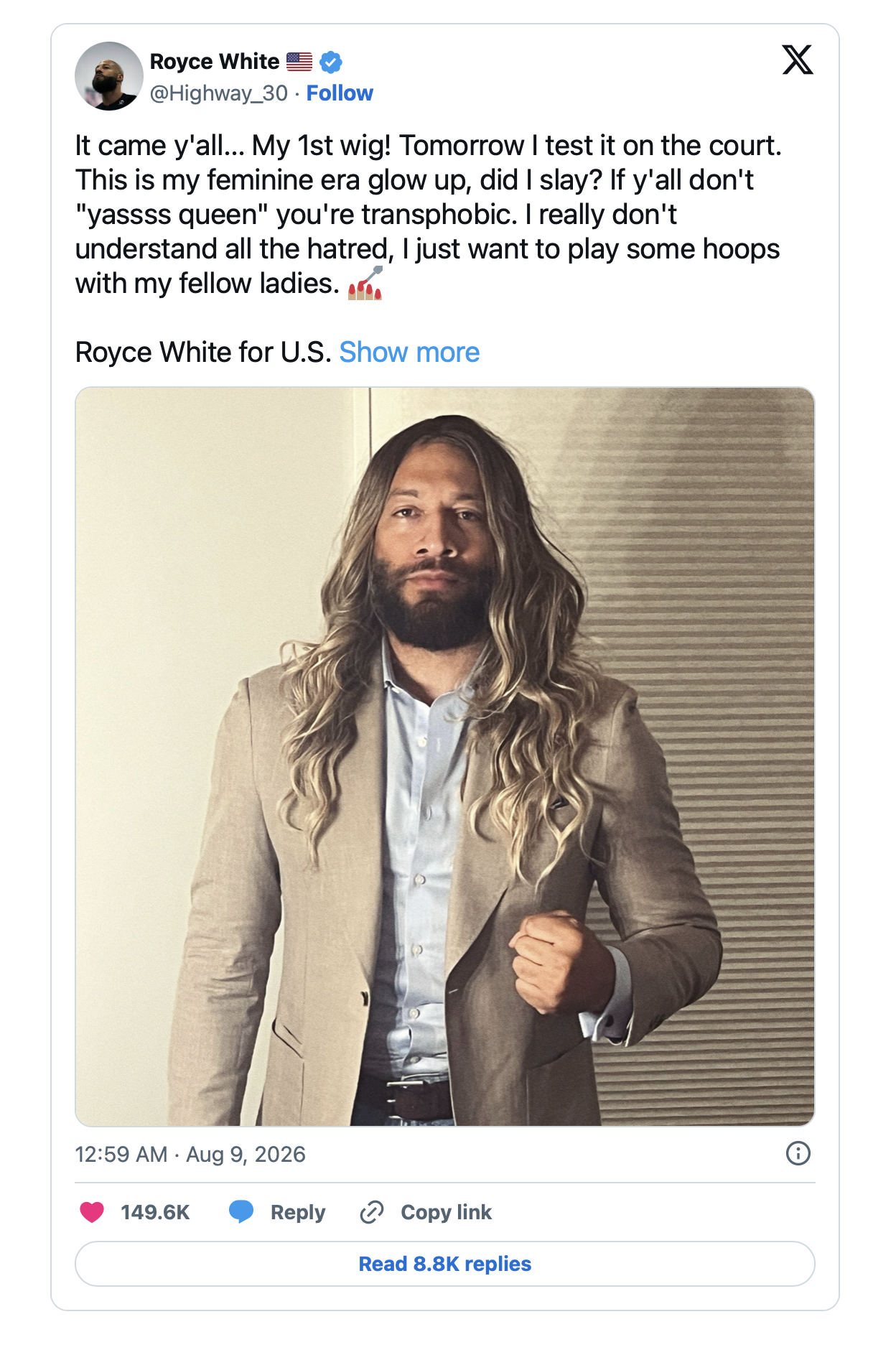
All of this has nothing to do with protecting women or women’s sports. It never did. Quite the opposite. WBNA games are exciting, its players (many Black and queer) are fabulously talented and their audience is growing. The far-right can’t stand it. The WBNA, to their credit, issued this statement: “There are no immediate eligibility matters affecting the WBNA, and we strongly denounce the bad-faith efforts to use these topics to demean or marginalize others.”
"They don't like women in sports because it helps us with confidence and power," Rapinoe recently said on TV show The View. "And we see so many women in the C-suite played elite level sports. It's just great for you physically and all. It's an attack on women in society."
That’s right. Ultimately, this isn’t even about sports. It’s about getting women out of higher education and the workplace and returning them to their roles as wives and mothers. To do this, the far-right needs to dismantle the laws that protect us against discrimination. Title IX isn’t a “failed experiment”: it’s a powerful tool that the far-right has set its sights on.
That’s why we must stand for trans persons. We cannot “concede” or trade off their rights for political calculation, as even some Democrats would urge us to do (looking at you, California Governor Gavin Newsom!). In the words of archbishop Desmond Tutu, “My humanity is bound up in yours, for we can only be human together.”
Let all girls and women play, and never forget where the harm really lies: patriarchy, misogyny, racism, transphobia and homophobia.
In solidarity with trans athletes,
FG